Living Apart Together in the Same House
Separate floors, a pink staircase and a rule that every visit is announced: how Karina Marais and her husband have shared one house, but not every room, for more than 20 years.

In short
- Living Apart Together in the same house means a committed couple keeping separate spaces in one home. It is not the same as separating under one roof.
- Karina Marais and her husband have kept separate floors for more than 20 years: his bachelor pad upstairs, her retreat downstairs, joined by a pink staircase.
- Their shared places are chosen, not left over: a glass folly reached by two walkways, a rooftop table, a table in the pool and a jacuzzi between the treetops.
- In a 2024 survey for the American Academy of Sleep Medicine, 29% of US adults said they had slept in another bed or elsewhere in the home to accommodate a bed partner.
“His bachelor pad is upstairs, my retreat is downstairs,” Karina Marais writes of the house she shares with her husband. For more than 20 years they have lived apart together without two addresses: one house, two floors, a staircase between them, and a rule that neither walks in unannounced.
If you found this page because you are separating and still sharing a house, this is a different situation. This guide is about committed couples who choose separate spaces under one roof: what that means, why couples do it, how one South African couple arranged their house and their week, and what to take from it if you are planning a home for two lives.
What it means to live apart under one roof
Living Apart Together, or LAT, usually describes a couple in an intimate relationship who live at separate addresses; that is the definition Wikipedia gives. The under-one-roof version keeps the relationship and the separate territory, and drops the second address. Each partner has private space, and the couple chooses which spaces, if any, to share.
It is not a new idea. The American author Anne L. Watson, who spent decades designing restorations of historic buildings, notes that a typical mansion was a large shell around a set of private apartments, most with one suite for the husband and another for the wife. Her own version began with a failed attempt at living together. She and her partner rented the whole top floor of an old four-unit building, two flats joined by interior doors, and tried to combine them. After six months they gave up, took a flat each, and later got back together without merging the flats again. They married in 2004 and, she writes, have lived apart together ever since.
How it differs from being separated at home
The difference is commitment. A couple who are separating may keep sharing a house for practical reasons while the relationship ends. A couple who live apart together under one roof are staying together, and the separate spaces are part of how they do it. You can see the difference in the diary: Karina’s Monday coffee and Tuesday dinner are dates, not handovers.
It is also different from a sleep divorce, which is about a bed rather than a home.
Why couples split one house
Sleep and routines
Sleep is often the first reason. In an online survey of 2,006 US adults commissioned by the American Academy of Sleep Medicine in May 2024, 29% said they had slept in another bed in the same bedroom, or in another space in the home, to accommodate a bed partner. The academy’s spokesperson, Dr Seema Khosla, said the term “sleep divorce” may sound alarming but is about looking after sleep and the problems that can wear a relationship down, such as snoring, tossing and turning, or different sleep schedules. If snoring is the cause, she suggested encouraging your partner to talk to a doctor about obstructive sleep apnoea.
Karina’s memoir gives the subject its own chapter, 9.4, “Personal Space, Sleeping, and Snoring”. Routines matter too. She describes herself as a morning person who likes to work from bed in the quiet early hours, “while the house is still peaceful”, and on the days they spend apart she has her coffee and a rusk to her favourite music as the sun comes up.
Privacy without distance
Watson’s book puts the case plainly: many committed couples would get along better if they were not also roommates. For most of her life, she writes, she made real sacrifices to avoid living with a roommate, from paying half her salary in rent to giving up on saving for a house.
Simon Duncan of the University of Bradford, whose research on couples who live apart is summarised in The Conversation, describes the promised advantage as autonomy: doing what you want in your own space, and keeping the arrangements and friendships you already have. His interviews add a caution. Some people choose distance to protect themselves after being hurt, and separate spaces do not stop old household roles from following a couple across the threshold.
Under one roof, privacy does not have to mean distance. A partner is a flight of stairs away, not across town, and a visit is a choice rather than a journey. That is how Karina and her husband have kept courting for more than 20 years: he still dates her, she told Get It magazine in January 2026, and dinner at her place comes by invitation.

Upstairs Downstairs A Musical Memoir
By Karina Marais · Paperback, e-book and audiobook
Inside the Upstairs Downstairs house
The memoir takes its title from this house, and Karina describes the house as more than bricks.
Our Living Apart Together home is not just a structure but a living symbol of a love that thrives in both togetherness and individuality.
The house was completed in 2008. Karina does not publish where it is, and neither does this guide. What she has published, in her book and in the chapter excerpts that accompany her songs, is how it works.
Two levels and a pink staircase
His bachelor pad is upstairs and her retreat is downstairs. The staircase between them links their spaces while keeping their independence, as the book’s blurb puts it, and Get It magazine’s profile added a detail the blurb leaves out: it is pink.
Each side has its own character. His glass-enclosed atrium is where they sometimes have breakfast or dinner when the weather permits: a still black pond lies beside the winding walkway to his front door, among cycads and a tiled island with high bar stools. Her favourite daydreaming spot is her bathroom: a chandelier over a round glass table, between a curved pebble wall and a curved window, and a make-up box covered in mirror mosaic, a housewarming gift from her eldest sister, that catches the sun and scatters it around the room.
Stairs run through the whole story: Karina even describes the steps she climbed in 1993, 1996 and 2003 as the crucial chapters of her life.
The knock-knock rule
Separate floors only work if they stay separate. The book’s blurb states the principle in three words, “No unannounced visits”, and Karina describes how it sounds in practice.
After 20 years of Living Apart Together, we still announce our visits to each other. We respect each other’s privacy and never enter unannounced.
She says, “Knock-knock, can I come in?” He answers, “Hello, anybody home?” Put together, the two lines give the blurb on her back cover its first words: “Knock-knock, anybody home?”
A room that belongs to both: the glass folly
The most unusual room in the house belongs to neither of them. The folly is a glass box among the treetops of the garden, which they call, with a smile, their “indigenous micro-forest”.
Our folly, perfectly sized for two reclining leather chairs and a coffee table, situates us among birds and treetops within the bushes.
Two walkways lead to it, one from each level. “We can easily walk to our mutual space from our distinct levels, whether upstairs or downstairs,” Karina writes. Her route winds over rocks and up a sudden twist of stairs to meet him at his level; she sees the two paths meeting in the treetops as a picture of two lives that took separate routes until they joined in 2004.
The folly was his idea, and he insisted on it despite the architects’ doubts. Karina had one condition of her own: the path had to suit high heels, because she pictured herself carrying a tray through the garden. The architects answered with a boardwalk that arches over the rocks. In early 2009, before the garden had grown in, passers-by took the tall glass structure for a lift to nowhere. Today it is where they meet for cappuccinos at noon, and for coffee on Wednesdays and at weekends.


The rooftop, the pool and the jacuzzi
The couple’s other meeting places are spread around the house. In chapter 10.3, “An Architect’s Insight into Hotels and Romance”, Karina numbers them as “spots”.
- The rooftop: reached by nine steps from the fourth level. It is covered in gravel with stepping stones laid so that she can cross it in heels with a tray or a glass of wine, and a small round granite table and two chairs stay there for drinks before dinner.
- Spot 2, by the pool: a dinner table for two in front of the pool’s glass wall, lit by LEDs whose colour she sometimes matches to the table setting.
- Spot 3, in the pool: a white table and chairs standing on a wide step in the heated pool, designed with the architects, for coffee, breakfast or a light lunch with their feet in warm water.
- Spot 6, the jacuzzi: set among the treetops, for a fruit platter at breakfast or a sundowner, with birdsong around them.
- Spot 16, bedside breakfast: a table set in front of his bed on weekend mornings.
- Spot 20, his atrium: caviar, champagne and a tagine by the black pond.
These beautifully laid tables throughout our home have become symbols of how we embrace life, finding beauty in every situation, no matter how ordinary.
The songs that go with these spots are on her album Living Apart Together in Love, from What Happens on the Rooftop… to Bedside Breakfast.
A week under one roof
The house explains the week. On Monday evenings at 7pm they have coffee in her space. On Tuesdays she invites him to a romantic dinner at her place downstairs, and the evening becomes a sleepover upstairs. Wednesdays and weekends bring coffee in the folly, and at weekends a breakfast table is set in front of his bed. Four days a week are apart days: coffee and a rusk, music and the sunrise, each on their own floor. The full rhythm, and the research on couples who live this way, is in the blog’s main guide to LAT.
Ideas for a house built for two lives
These ideas come from one house and one couple, and from Watson’s experience. They are ideas, not rules; take what fits your home and your relationship.
- Give each person a door to knock on. Private space only stays private if visits are announced.
- Make one room that belongs to both, ideally reachable from each side, as the folly is.
- Plan meeting places, not just rooms. A rooftop table, a seat by the pool or a bench in the garden gives time together somewhere to happen.
- Design paths for how you really move. Karina asked for a boardwalk she could walk in heels with a tray, and got one.
- Keep a table ready. On their roof the granite table and two chairs stay in place; around the house, set tables are carried wherever they choose.
- Decide on sleep deliberately. Separate beds or rooms are a common choice, and a persistent snore is worth a doctor’s visit.
- Put the rhythm in writing. Fixed dates, like Monday coffee and Tuesday dinner, turn separate lives into a shared week.
What the book adds
Upstairs Downstairs: A Musical Memoir tells the story of the house in several chapters: 1.2, “Upstairs Downstairs”, with the knock-knock rule and the folly; 9.1, “Swan Songs and Morning Rituals”; 9.4, “Personal Space, Sleeping, and Snoring”; and 10.3, “An Architect’s Insight into Hotels and Romance”, which maps the spots above.
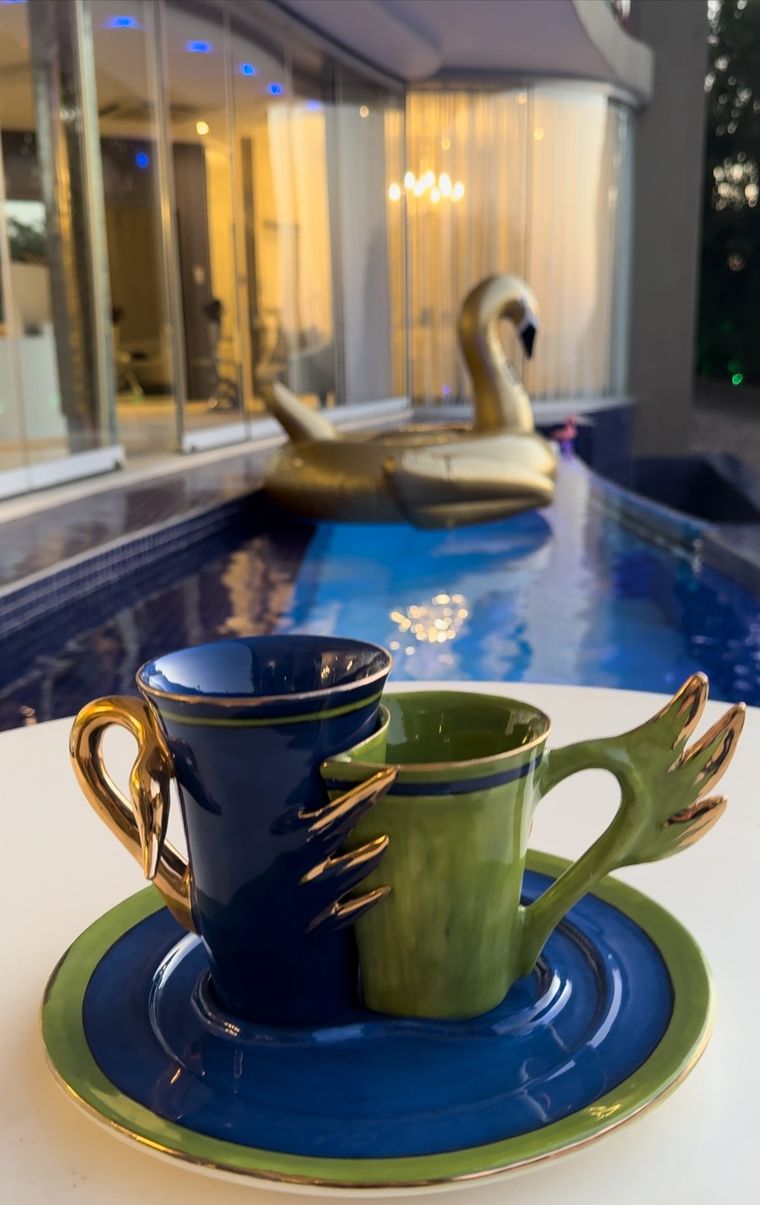
The house has its own love song, “Upstairs Downstairs”, and Karina’s account of it is in her notes on the lyrics. Two cups sum the arrangement up: the Swan Cups, one cobalt blue and one lime green on a single saucer, which are sold with a copy of the memoir at Forum Homini.
For what happened when the couple married after 18 years and kept both floors, read married and still living apart.
Questions and answers
Can a couple live apart together in the same house?
Yes. Karina Marais and her husband have used separate levels of one house for more than 20 years: his bachelor pad upstairs, her retreat downstairs, joined by a pink staircase, with a few shared spaces they chose on purpose.
Is that the same as being separated under one roof?
No. A couple who are separated but still share a house are ending their relationship. Living Apart Together under one roof means a committed couple choosing separate spaces and staying together, with time together planned rather than avoided.
What is a sleep divorce?
Sleeping in separate beds or bedrooms so that both partners sleep better. In a May 2024 survey of 2,006 US adults for the American Academy of Sleep Medicine, 29% said they had slept in another bed in the same bedroom, or elsewhere in the home, to accommodate a bed partner. The academy's spokesperson named snoring, tossing and turning, and different sleep schedules as the kind of problems it addresses.
How do you keep privacy in one house?
Karina Marais's answer is a rule: every visit is announced. She says, 'Knock-knock, can I come in?' and he answers, 'Hello, anybody home?' Dinner is by invitation too: on Tuesdays she invites him to her place downstairs.
How often do they spend time together?
They keep a weekly rhythm: coffee at 7pm on Mondays in her space, dinner at her place downstairs on Tuesdays followed by a sleepover upstairs, coffee in their shared glass folly on Wednesdays and weekends, and breakfast at a table set in front of his bed at weekends. Four days a week are apart days.
Sources
- Americans opting for 'sleep divorce' to accommodate a bed partner (opens in a new tab)
- Living apart together (opens in a new tab)
- Why more couples are choosing to live apart (opens in a new tab)
- Living Apart Together: A Unique Path to Marital Happiness (opens in a new tab)
- Love, laughter, and a pink staircase (opens in a new tab)
Karina Marais
Karina Marais is a South African educator, entrepreneur, and now creative storyteller, songwriter and author who is possibly breaking new ground in memoir writing.
About Karina