Living Apart Together: A 20-Year Love Story, Explained
What Living Apart Together is, how many couples choose it and why, told through the rules and the weekly rhythm Karina Marais and her husband have kept for more than 20 years.

In short
- Living Apart Together (LAT) is a committed couple choosing separate homes, or separate spaces in one home. The term took hold in the Netherlands in the 1970s.
- Surveys put LAT at around one adult in ten in several Western countries; in 2023, 12.5% of US newlyweds lived apart for reasons other than separation.
- Karina Marais and her husband have lived this way for more than 20 years: his bachelor pad upstairs, her retreat downstairs, and every visit announced.
- Not everyone chooses it for freedom: Simon Duncan of the University of Bradford found that many who prefer to live apart are protecting themselves after earlier hurt.
“Knock-knock, anybody home?” is how Karina Marais opens the story of her relationship, and the knock is real. For more than 20 years she and her husband have shared one house but not one set of rooms: in the words of her book’s blurb, “his bachelor pad upstairs, her retreat downstairs”, with a staircase between them and an agreement that neither walks in unannounced.
That arrangement has a name. Living Apart Together, or LAT, describes a committed couple who choose not to live under the same roof or, as in this case, not in the same rooms. This guide explains what the term means, what research says about who does it and why, and how one South African couple has made it work since their paths joined in 2004, from their house rules to their weekly rhythm. It also sets out the downsides, which are real, and the questions worth asking before you try it.
What Living Apart Together means
Living Apart Together means two people in a committed, intimate relationship who deliberately keep separate homes. The standard definition, on Wikipedia and in the studies cited below, is an intimate couple living in separate households. Karina’s version stretches it: one address, two separate lives, and a few shared spaces the couple chose on purpose rather than inherited by default.
A choice, not a separation
The word that matters is choice. A couple who are separating may still share a house while they untangle their lives; that is the end of a relationship, not a form of it. LAT couples stay together and decide, together, how much of daily life to share.
Not every couple who lives apart does so by choice, though. According to the research summarised on Wikipedia, about a third of LAT couples feel it is too early to move in together, while others would like to but are held back by housing costs or, more rarely, where their jobs are. Simon Duncan, emeritus professor of social policy at the University of Bradford, describes a third group who prefer to live apart over the long term, mostly older people who have been married or lived with a partner before. Karina belongs to that third group: a woman who could have moved in with the man she loves, and chose not to.
Where the term comes from
The phrase became popular in the Netherlands in the 1970s, helped by Pim de la Parra’s film Frank en Eva, which carried “Living Apart Together” as its tagline. Researchers now use the initials LAT; Karina uses the full phrase in the titles of two of her albums.
How many couples live apart together?
The estimates come from different surveys in different countries, but they point the same way.
Across Western countries
Surveys suggest that around 10% of adults in Western Europe, the US, Canada, New Zealand and Australia live apart together, Duncan writes in The Conversation. He adds that up to a quarter of people in Britain who are counted as single in fact have an intimate partner. The figures summarised on Wikipedia agree: around 10% of adults in Britain in the early 2000s, similar shares elsewhere in northern Europe, and between 6% and 9% of unmarried adults in Australia, Canada and the US with a partner who lives elsewhere.
Older couples
Among older people, the research summarised on Wikipedia finds that Living Apart Together is generally a stable alternative to living with a partner. A study by Yang Hu of Lancaster University and Rory Coulter of University College London, published in the Journal of Gerontology: Series B and reported by Lancaster University in December 2024, used UK household data from 2011 to 2023. It found that around 4% of over-60s in the UK live apart together. Compared with single people of their age, they reported less mental distress and better wellbeing, a benefit the researchers found comparable to that of marriage or living together. Women and men benefited alike, although earlier research had found that marriage and cohabitation favour men’s mental health. Leaving a LAT relationship also took a far smaller toll than leaving a marriage or a shared home. For single women over 60, LAT was about ten times more likely than marriage or cohabitation as the next relationship; for single men, about ten times more likely than marriage and nearly twenty times more likely than moving in together.
Married couples
A wedding does not always end it. Census Bureau figures cited on Wikipedia show that the share of married couples living apart rose by a quarter between 2000 and 2019, and put the number of Americans living apart from their spouse at 3.89 million in 2022, nearly 3% of married Americans, whatever the reason. A narrower measure from the National Center for Family & Marriage Research at Bowling Green State University counts newlyweds, people married in the past year, who live apart for any reason other than separation: 12.5% in 2023, down slightly from 13.4% in 2018 but more than double the 5.7% of 1980.
Karina belongs to the same group on another continent. She married in October 2022, after 18 years of LAT, and kept her own floor. That part of the story has its own guide: married and still living apart, after the wedding.

Upstairs Downstairs A Musical Memoir
By Karina Marais · Paperback, e-book and audiobook
One couple’s LAT, up close
Numbers show a trend; they do not show how a relationship like this runs from Monday to Sunday. Karina Marais has published unusual detail about her own, in her memoir, Upstairs Downstairs: A Musical Memoir, and in the chapter excerpts she posts alongside her songs.
One house, two lives
The house was completed in 2008. His rooms are upstairs, hers are downstairs, and the staircase between them, the blurb says, links their spaces while preserving their independence. The rest of the house, from the glass folly to the rooftop, has its own guide to how they share one roof.
The idea is older than the house. After her divorce in 2003, a painting of a two-faced woman in Karina’s hallway began to stand for the life she wanted, balancing two sides: “one with my boys and the other with the new man in my life, my lover.” She did not yet know how, she writes, but she “was determined to create a new relationship model with my new partner.” The song that tells this part is The Artwork that Mirrored my Future Life, from chapter 7.1, “Two Faces in the Hallway”.

The rules they have kept
Two phrases from the blurb work as house rules: “No unannounced visits, no dull routines.” The first is taken literally.
After 20 years of Living Apart Together, we still announce our visits to each other. We respect each other’s privacy and never enter unannounced.
She says, “Knock-knock, can I come in?” He answers, “Hello, anybody home?”
A second rule covers what they think rather than where they sleep. “From the beginning, we agreed to give each other the freedom to hold our own beliefs without the need to convince or convert one another,” Karina writes, a promise that mattered most on religion and politics.
The third keeps the romance deliberate. More than 20 years on, he still dates her, she told Get It magazine in a profile published in January 2026, and dinner at her place comes by invitation. Standards count too: during lockdown they kept dressing as if they were going out, on the days they spent apart as well, and she writes that she did not own a tracksuit and had no plans to buy one.
A week in their relationship
Karina is precise about the rhythm, and open about it. Every couple in a LAT relationship “creates unique routines that suit their needs and lifestyles”, she writes, and she shares theirs to give an honest picture of how one couple manages.
The song for the week is Dinner at my Place, from chapter 1.2, “Upstairs Downstairs”, the chapter that describes the knock-knock rule and their week.
Coffee, trays and two swan cups
Much of this relationship happens over coffee. On the mornings they spend together, Karina makes it. She chooses the tray and cups the night before from a collection of trays and cups in different colours, shapes and styles, and adds a flower, scattered rose petals or another small token, a habit she learned from her mother-in-law.
These small details transform an ordinary act into something special, a ritual that has bound us together for over 20 years.
Two cups carry the whole idea. The Swan Cups, one cobalt blue and one lime green, share a single saucer, and to Karina they are “a perfect reflection of our relationship: two hearts, two homes, yet always connected.” They have their own popera song, Swan Cups of Love, and a set is sold with a copy of the memoir at Forum Homini Boutique Hotel.
Why couples choose it
Time and space of one’s own
The most obvious reason is also the simplest: time that belongs to you. Karina is a morning person who likes to work from bed in the quiet early hours, coffee in hand, a homemade rusk for dipping. Later she makes a breakfast for one that she treats as a canvas. “It allows for dreaming, creating a fantasy land on a plate,” she writes. On apart days, her song Apart, not Alone makes the same point: a day alone is not a lonely day.
For older people entering a new relationship, the Lancaster researchers call LAT a balanced option: a marginally smaller gain in mental health than marriage, with far less exposure to risk.
Space also leaves room for ambition. The book’s blurb describes a relationship “where love, ambition, and independence coexist”, and Karina’s working life bears that out. She co-founded the educational NGO BrainBoosters, created the Running with Bulls financial-literacy board game, presented a KykNet television series on children and money, and more recently wrote a memoir and the lyrics for three albums.
Staying in the “dessert phase”
Karina’s own favourite explanation comes from a film.
By staying in the “dessert phase”, we keep the romance and excitement alive without the challenges that often come with living together.
In The Taste of Things, she explains, marriage is compared to a dinner that begins with dessert, the honeymoon phase; living apart lets them keep indulging in that sweetness. The idea is in chapter 7.6, “Love’s Logistics”, and at the Dare2Dream dinner it is served literally: Purple Pears, a dessert, arrive as the fifth of eleven courses.
Old hurts and family ties
Karina came to LAT through two divorces. The first was her parents’. “As I look back on these painful years of my parents’ divorce, I can still feel the weight of the hurt, but also the strength it took to forgive, to heal, and to hold onto love despite it all,” she writes of the song Love, Memories & Forgiveness. Having lived through that, she told Get It, she did not want to repeat her parents’ mistakes. The second was her own, in 2003, after a 20-year marriage.
Duncan’s research adds a counterweight worth taking seriously. His team’s nationwide survey and 50 in-depth interviews found that many people in the “preference” group had been deeply hurt in earlier relationships, financially as well as emotionally, and some women had experienced abuse. For them, living apart was less a new kind of intimacy than a form of protection. Karina describes her arrangement as a model she set out to design. Duncan’s finding is a reason for any couple to ask which describes them.
The downsides, honestly
Living Apart Together is not a cure for a difficult relationship, and it has costs of its own.
- Money. Two households, or one house built for two separate lives, cost more than one shared home.
- Planning. Time together has to be arranged rather than assumed. Karina’s fixed dates show how much of their week is planned.
- Fear, not freedom. As Duncan found, distance can be a defence against being hurt again, which is a different thing from wanting space.
- Old roles. Separate homes do not guarantee a fairer split of work. In Duncan’s interviews, one woman who felt that living apart gave her power still found herself doing all her partner’s washing and cooking.
- Arguments still happen. Karina records one serious fallout, on holiday on Hainan island in the South China Sea; she notes that it had nothing to do with religion or politics. It is the story behind Hainan, O Hainan Chicken.
Living Apart Together with children
For Karina, children were part of the reason. She met her partner after her divorce, with two sons of her own, and chose to keep the two sides of her life apart. The couple raised their children separately, she told Get It.
That will not suit every family, and the studies cited here say little about children in LAT households. What the arrangement does bring into the open are the questions a blended family faces: whose rules apply in which home, how a new partner is introduced, and who turns up for the school play. Two of the books on this blog’s reading list about Living Apart Together take the question on directly: one is written partly for single parents who want an alternative to a blended family, the other has a chapter on kids and elders.
Is LAT right for you? Questions to talk through
These questions come from the rules Karina describes and from the research above. They are prompts for a conversation, not a test.
- Why do we want this? For freedom and space, or to protect ourselves after being hurt?
- Where will each of us live, and which spaces, if any, will we share?
- How will visits work? An open door, or a knock first?
- Which days are together, and which are apart? Write the rhythm down, as Karina does.
- How will we share the costs of two households, or of one house built for two lives?
- What will we do about children, from before or from now?
- Can we hold our own beliefs without trying to convert each other?
- What happens as we age, or if one of us needs care?
Read, listen, watch
- Read: Upstairs Downstairs: A Musical Memoir by Karina Marais. Part 7, “The Anatomy of a LAT Relationship” and Part 9, “LAT Rituals, a Fallout, and Other Insights” cover the arrangement in detail. She narrates the audiobook herself.
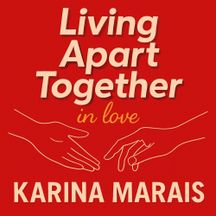
- Listen: the album Living Apart Together in Love, 17 songs about the rituals of their LAT home, part of 32 tracks, including a medley, across three albums.
- Watch: “Apart, Not Alone”, filmed for chapter 9.1, below.
- Taste: the story now has a restaurant. The Dare2Dream Dome at Forum Homini in the Cradle of Humankind serves it as an 11-course dinner, each dish presented, in her words, as “a tale, a song, and a taste”.

Next, see how the arrangement works in bricks and mortar, or read on about what changes, and what does not, after the wedding.
Questions and answers
What does Living Apart Together mean?
A couple in a committed, intimate relationship who choose to keep separate homes instead of moving in together. The standard definition speaks of separate addresses; some couples, like Karina Marais and her husband, keep separate spaces under one roof. The term became popular in the Netherlands in the 1970s.
How common is Living Apart Together?
Surveys suggest around 10% of adults in Western Europe, the US, Canada, New Zealand and Australia live apart together (Simon Duncan, The Conversation). In the UK, about 4% of people over 60 do (Lancaster University, 2024).
Does Living Apart Together work long term?
It can. Couples choose it for different reasons: some for freedom, some because they are not ready to move in, and some out of caution after earlier hurt (Duncan). Karina Marais and her husband have lived this way for more than 20 years, and kept the arrangement after they married in 2022.
How often do LAT couples see each other?
There is no rule; each couple sets its own rhythm. Karina's week has coffee at 7pm on Mondays in her space, dinner at her place on Tuesdays followed by a sleepover upstairs, coffee in their shared glass folly on Wednesdays and weekends, and four apart days.
What are the downsides of Living Apart Together?
Two households, or one house built for two separate lives, cost more than one shared home. Time together has to be planned. Research also finds that some couples choose distance out of fear rather than freedom, and that old household roles can follow them across the threshold (Duncan).
Can married couples live apart together?
Yes. In 2023, 12.5% of US newlyweds were living apart from their spouse for reasons other than separation (Bowling Green State University). Karina Marais married after 18 years of LAT and kept her own floor.
Sources
- Living apart together (opens in a new tab)
- Why more couples are choosing to live apart (opens in a new tab)
- Study brings to light new picture of intimate relationships among older adults (opens in a new tab)
- Married and Living Apart Together (Family Profile FP-25-27) (opens in a new tab)
- Love, laughter, and a pink staircase (opens in a new tab)
Karina Marais
Karina Marais is a South African educator, entrepreneur, and now creative storyteller, songwriter and author who is possibly breaking new ground in memoir writing.
About Karina