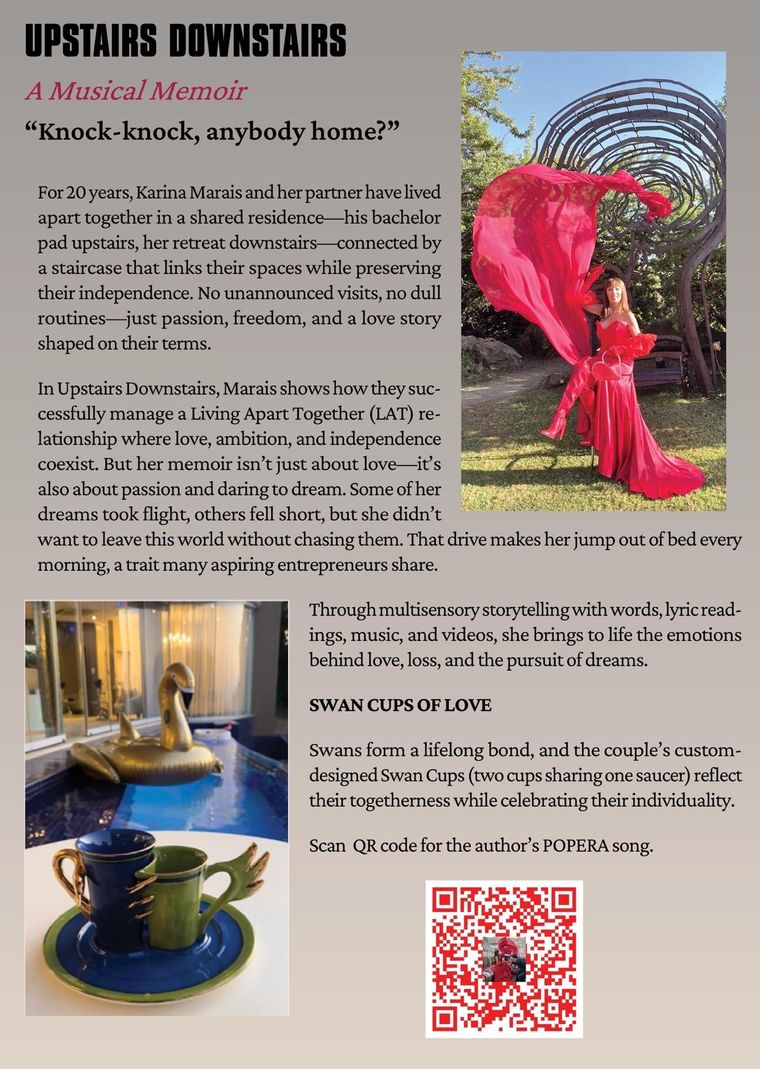
From Memoir to Music: How 32 Songs Were Made
Karina Marais wrote the lyrics for 32 tracks, including a medley, with no musical background. Her method in four steps, what songwriting teachers advise, and how she credits AI.
In short
- Karina Marais had no musical background. She wrote every lyric and briefed composers on the genre, mood and voice she wanted.
- The result is 32 tracks, including a medley, on three Spotify releases, each placed in a chapter of her memoir.
- Her culinary guide says the songs pair her lyrics with global artists and AI-generated melodies and voices.
- Spotify allows music made with AI, bans unauthorised voice clones and backs AI credits in song information (September 2025).
How do you write songs about your life? Pick the few moments that carry the story. Write each lyric from one true detail. Decide the mood before anyone writes a note. Choose a voice that suits the song. And say plainly who, and what, made the music. That, in outline, is how Karina Marais, a South African educator and entrepreneur with no musical background, turned her memoir into 32 tracks, including a medley, across three releases on Spotify.
Her notes on the songs are unusually complete. For eleven songs on the first album she published the story behind the song, the lyrics and her brief to the composer; for the other albums, her video descriptions carry the passage from the memoir behind each song. Together they make a worked example of a method anyone with a life story can use.
Starting with no musical background
Karina Marais is clear about where she began. On her music page she writes:
While I don’t have a musical background, music has become a powerful medium for storytelling in my life in 2024.
Her first album came out in December 2024 as Upstairs Downstairs Romance, with 11 original songs. By mid-2025 there were three releases on Spotify: Upstairs Downstairs (Songs from my Memoir), 12 tracks including a medley; Living Apart Together in Love, 17 tracks; and Living Apart Together in Love (2), three tracks, which Spotify files as a single and she calls her third album. That makes 32 tracks, including a medley, and about 103 minutes of music. Her memoir, Upstairs Downstairs: A Musical Memoir, followed in January 2026 with every song placed in a chapter. The three releases and their track lists are on this site.
The division of labour was simple. She wrote the words; the melodies and voices came from others, and in part from AI. The first song arrived from a producer in Bali, and her culinary guide describes the day it came: the couple celebrated with cava and caviar, and she cried.
I’m no singer, yet I found a way to deliver my love through a song to my dream man.
Step 1: pick the moments that carry the story
A memoir holds hundreds of moments; a song can carry one. Karina’s book runs to twelve parts, from Part 0 to Part 11, but only some chapters have a song. Those she chose fall roughly into three groups, one for each release.
- The arc of a life. The first album moves through the big turns: the urge to dream, a childhood love of fashion, her parents’ divorce, her own divorce in 2003, dating again in her mid-40s, meeting the man she calls her soulmate, their beach wedding, and contentment at 65.
- The rituals of a relationship. Most of the second album is about how she and her husband have lived apart together for more than 20 years: dinners by the pool, coffee in a glass room between the treetops, breakfast set out in unexpected places.
- Food and memory. The third collects three dishes with stories: bread in hot milk from her childhood, the snow crab she might choose as a last supper, and a chicken dish from a holiday on the island of Hainan.
The lesson for anyone writing about their own life is to choose turning points and repeated rituals, and let the rest of the story stay in the prose. The book’s contents, part by part, show where each song sits.
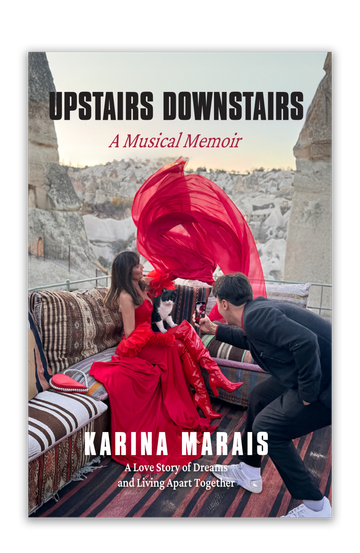
Upstairs Downstairs A Musical Memoir
By Karina Marais · Paperback, e-book and audiobook
Step 2: write the lyric from one true detail
Many of Karina’s songs begin not with a feeling but with a thing she could see, touch or taste; the feeling follows.
- Fashion My Lifelong Passion starts with a pair of red patent-leather shoes she had at eight, and the sewing she learned from her mother.
- The Artwork that Mirrored my Future Life comes from a painting of a two-faced woman in her hallway. After her 2003 divorce, she began to see the woman in it as someone with two lives: one with her sons, one with her new partner.
- Wings of Words grew from a gift from her former husband: a sculpture of an abstract bird, and a poem.
- Swan Cups of Love is built on two cups, one cobalt blue and one lime green, that share a single saucer.
- Haute Lamb Tails for Two goes back to a cold morning on a Karoo farm in the late 1960s, when lamb tails were tossed straight onto an open fire.
- Chunks of Bread in Steaming Hot Milk is her mother’s rainy-day treat: stale bread torn into a tall glass, a layer of sugar, steaming milk and cinnamon.
A detail does two jobs. It makes the story believable, and it gives the listener something to hold while the emotion lands. If you are starting your own, look for the object, the colour, the date or the taste that you still remember exactly. On this site, each song page carries the story behind the song, and the Lyrics explained page has all eleven stories from the first album in her own words.
Step 3: brief the composer on a mood
With the words written, Karina briefed the composers on how the songs should feel. Her briefs for the first album, published with the lyrics, are short and specific:
| Song | Her brief, in short |
|---|---|
| Dare to Dream as If There’s No Tomorrow | An epic movie theme song |
| Fashion My Lifelong Passion | Dreamy and nostalgic |
| Love, Memories & Forgiveness | Haunting and emotional, simple and powerful |
| Wings of Words | Haunting, bitter and sweet, ending in peace |
| A Man in a Million | A female rapper |
| The Artwork that Mirrored my Future Life | A cinematic ballad |
| Upstairs Downstairs | Vibrant, tender pop, “definitely not sad” |
| Swan Cups of Love | Popera: a male pop voice with a female opera voice |
| Our Culinary Love Affair | A fun, feel-good, sensual jazz duet |
| Cherry Blossoms | The beach at Paternoster in October 2022: waves, seagulls, violin |
| Content, Complete in Every Way | A Disney-style movie theme song |
Three things stand out. Most briefs name a form, so the composer knows the territory: a movie theme, a ballad, a rap, a duet, popera. Most also name a feeling, and one names what to avoid: the love song “Upstairs Downstairs” was to be “definitely not sad”, although it describes two people on two floors. And the best briefs give the composer a picture. For “Cherry Blossoms”, the song about their wedding, she asked for the sound of the day itself: the breaking waves, the seagulls and a violin.
You do not need musical vocabulary to write a brief like these. You need to know how the moment felt and what it sounded like.
Step 4: choose the voice
Because she is, in her own words, no singer, Karina could choose any voice for any song, and she used that freedom. For “A Man in a Million”, about dating again in her mid-40s, she wanted something unconventional, a playful twist, and chose a female rapper. “Upstairs Downstairs”, the love song, is credited on her lyrics page to Fleur, Rene and Aimee Marais. For “Our Culinary Love Affair” she asked for a duet.
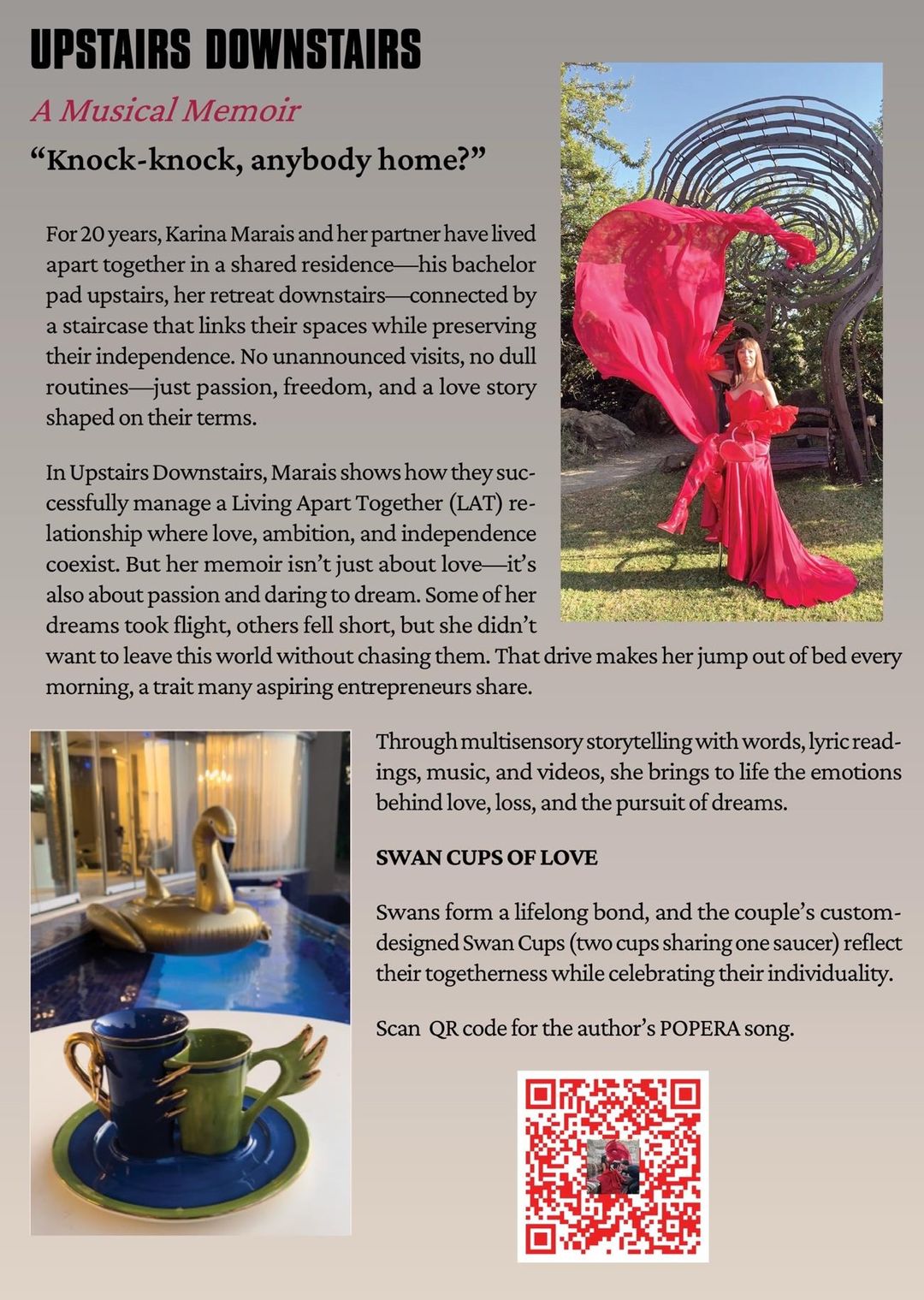
The boldest choice is “Swan Cups of Love”. The cups are two cups on one saucer, a picture of a couple who live apart together, and she wanted the music to be just as unusual: a popera, pairing a male pop voice with a female opera voice. The song now has a place on the book itself: the back cover carries a QR code that opens a video of it.

Where AI came in, and how to say so
Karina has not hidden how the music was made. Her culinary guide says it in one line: “All songs feature lyrics by KARINA MARAIS with global artists and her AI-generated melodies & voices.” Her Lyrics Explained page lists “Lyricist: Karina Marais” on every entry, then an artist line that varies: “AI” on some songs, “Anonymous” on others, and the Marais names on the love song. The player on her music site marks most of the second album’s songs “AI Generated”. IOL’s review of the book made the same point: every lyric is hers, the composers worked from her briefs, and she was open about using AI tools for several tracks.
The names of the producer and the composers have not been published, and this page does not guess at the tools. What it can say is how the streaming services now treat music like this. In September 2025, Spotify announced three changes. Vocal impersonation, including AI voice clones, is allowed only when the artist being imitated has authorised it. A new spam filter targets mass uploads, duplicates and artificially short tracks; Music Business Worldwide reported that Spotify had removed more than 75 million spam tracks in the previous twelve months. And Spotify is backing an industry standard, developed through DDEX, for AI disclosures in song credits, so labels and distributors can state where AI played a part: in the vocals, the instrumentation or the post-production. Spotify said the aim is not to punish artists who use AI responsibly.
For a memoir writer, the practical rule is the one Karina followed: credit yourself for what you wrote, credit the people who performed where you can, and say where AI came in.
What songwriting teachers advise
Gary Ewer, who writes The Essential Secrets of Songwriting, gives a four-step method for turning a story into a song. List the story’s major events. Cut them to three or four, dropping subplots and folding related moments together. Let the verses carry the events and give the chorus the emotional reaction, the part a listener can share. Then place the story’s turning point in the bridge. He also lists what makes stories hard to sing: too many words, too many characters, slow pacing and distracting subplots.
Karina’s songs line up with most of this. Most take a single event or ritual from a long book, and the first album as a whole works like a series of verses about the turning points of a life. “Cherry Blossoms” builds its chorus on the promise from the couple’s wedding vows, which they made in Afrikaans, so the song’s feeling sits where Ewer says it should. Where she adds something to the textbook is at the start: the one true detail her songs grow from.
If you are trying this with your own story, write the list of events first, choose three, and for each one find the detail you could still draw from memory.
When the words stand alone: lyric readings
Karina has also read her lyrics aloud. Her podcast on Spotify, which shares the book’s title, has an introduction and eleven lyric readings of the first album’s songs, all published on 17 March 2025, each three to five and a half minutes long. In each she reads the lyric of one song, and the episode notes open with the story behind it, the same stories collected on the Lyrics explained page.
Reading a lyric aloud is a useful test. Without a melody to carry it, a line either stands up as writing or it does not. Her readings also show another path for a memoir writer who is not ready to make music: the lyrics can live in the book and in your own voice. She narrated the audiobook of the memoir herself, nearly eleven and a half hours of it.
To see how the songs fit the book as a whole, read what a musical memoir is, and how this one stretches the form. The songs also leave the page at her dinner in the Cradle of Humankind, where most courses are served with one of them: see how each course pairs a song with a chapter. And the words themselves are in the memoir, with every song placed in its chapter.
Questions and answers
Can you write songs without a musical background?
Karina Marais did. She wrote the lyrics for 32 tracks, including a medley, and briefed composers on the genre, mood and voice she wanted; the melodies and voices came from global artists and AI, as her culinary guide says.
How do you turn a life story into lyrics?
Gary Ewer, who writes The Essential Secrets of Songwriting, suggests cutting the story to three or four key events, letting the verses carry the events and the chorus carry the feeling. Karina's songs add a second rule: start each lyric from one true, specific detail, such as a pair of red shoes or two cups on one saucer.
What goes in a composer brief?
The mood, the genre and the voice. Karina's briefs ask for things like an epic movie theme, a dreamy and nostalgic melody, popera with a male pop voice and a female opera voice, or a fun, sensual jazz duet.
Did Karina Marais use AI?
Yes, openly. Her culinary guide says her songs pair her lyrics with global artists and her AI-generated melodies and voices, and her Lyrics Explained page credits AI as the artist on some songs, 'Anonymous' on others, and three named singers on the love song.
Does Spotify allow AI-assisted songs?
Yes, with rules. In September 2025 Spotify said vocal impersonation needs the artist's permission, that a new filter would target spam uploads, and that it backs a DDEX industry standard for AI disclosures in song credits. It said the aim is not to punish artists who use AI responsibly.
Where can I read the lyrics and the stories behind them?
On the Lyrics explained page of this site, which carries her 11 entries for the first album: the story behind each song, the lyrics and her brief to the composer.
Sources
- Turning a Good Story Into a Good Song (opens in a new tab)
- Spotify Strengthens AI Protections for Artists, Songwriters, and Producers (opens in a new tab)
- Spotify has deleted 75m+ 'spammy tracks' – as it unveils new AI music policies (opens in a new tab)
- A Staircase Between Two Lives (opens in a new tab)
Karina Marais
Karina Marais is a South African educator, entrepreneur, and now creative storyteller, songwriter and author who is possibly breaking new ground in memoir writing.
About Karina